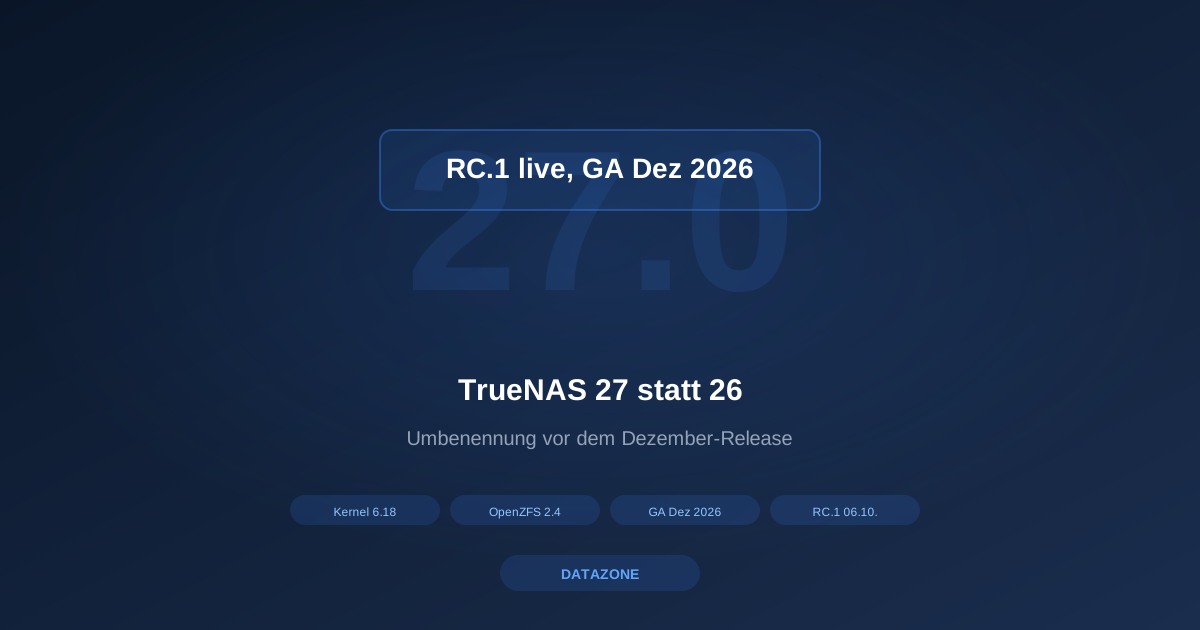
Two weeks before the planned December release, iXsystems made a small but consequential decision: the successor to 25.10 Goldeye, until now developed under the name TrueNAS 26, is called TrueNAS 27 from Release Candidate 1 onwards. The official announcement appeared on 6 October 2026. What looks cosmetic at first has a few practical consequences for release planning — and it ends the familiar YY.MM naming convention that has been in place for years.
Here is the context: what actually happened, what does not change with the rename, and which questions admins should ask for the planning of their storage projects in Q4 2026 and Q1 2027.
What iXsystems is changing
The successor to TrueNAS SCALE 25.10 Goldeye has been in development since May 2026 as TrueNAS 26 (Beta.1 through Beta.3). With Release Candidate 1 on 6 October 2026, the version is officially called TrueNAS 27.0. The rationale in the iXsystems post is pragmatic: users typically run a version in production during the year after availability, and the version number should reflect that primary deployment year. TrueNAS 27 will mainly see production use in 2027.
With this decision, iXsystems leaves behind the previous year-month scheme (25.10, 25.04, 24.10, 23.10 and so on). Dot releases within TrueNAS 27 will now be counted sequentially and no longer tied to a specific calendar month. That simplifies external communication but breaks a convention that has been in place for more than three years.
What does not change
Despite the new name, the release planning itself is unchanged. GA of TrueNAS 27.0 is still scheduled for early December 2026. The path there runs through the familiar beta-RC cascade; the currently published build is RC.1. After RC.1, iXsystems historically typically ships one or two more RC builds before GA is cut.
The technical base of the release does not change with the rename either. The two confirmed anchor points from the announcement post are:
- Linux kernel 6.18 as the base for new hardware support, improved container isolation and refreshed drivers.
- OpenZFS 2.4 as the file system foundation with the improvements from the last OpenZFS cycles, including further optimised direct-IO paths and RAIDZ expansion maturity.
Concrete feature lists, breaking changes and the enterprise feature differentiation will be documented in the iXsystems RC.1 feature posts. For planning, the top-level perspective is enough: kernel and OpenZFS are the two most important technical lines on which compatibility and stability are decided.
What this means for Q4/Q1 planning
For running and planned storage projects, the rename raises three concrete questions:
1. Should I wait for TrueNAS 27.0?
For production environments, usually no. TrueNAS 25.10 Goldeye is stable, broadly tested, and will continue to receive updates for a long time. Anyone ordering or commissioning a TrueNAS system today gets and runs it sensibly on 25.10. The move to 27.0 is typically a topic for the first half of 2027, once the first 27.x minor releases have cleared the typical early-release wrinkles.
2. Can I still buy 25.10?
Yes. The current 25.10 line is the stable enterprise release and will remain so until the regular end-of-life announcement. For projects currently in planning or close to purchase, 25.10 is the clean choice. iXsystems typically operates SCALE branches with patches across several minor cycles — concrete EOL dates for 25.10 will be communicated with the GA of 27.0 in December.
3. What about the Proxmox plugin?
The official TrueNAS Proxmox plugin, which we discussed in our practitioner contribution on the early-adopter status, currently relies on TrueNAS SCALE 25.10.6 or later. For 27.0 an updated plugin version will very likely be needed — iXsystems has hinted at this in previous communications but has not yet published a concrete compatibility matrix. Admins already using the plugin in production should only move to 27.0 after an explicit go-ahead from the plugin roadmap.
Tech base: kernel 6.18 and OpenZFS 2.4 — what it means in practice
Linux kernel 6.18 is, at the time of TrueNAS 27 development, a fresh but already widely deployed mainline kernel. For storage appliances this primarily brings two things: a refreshed hardware support matrix (newer NICs, NVMe controllers, HBAs) and further matured Linux container isolation for the TrueNAS Apps platform. For existing hardware that has been in service for 2–3 years, the kernel jump is uncritical in practice.
OpenZFS 2.4 is the next major cycle after 2.3, with several practice-relevant improvements. RAIDZ expansion has matured further, direct-IO paths for NVMe workloads have been stabilised, and several performance edge cases on very large pools have been addressed. For admins already running 2.3-based TrueNAS versions, 2.4 is an incremental but welcome step — not a big-bang rebuild at the file system layer.
How we scope this for our customers
As an authorised iXsystems partner in Germany, we track the beta/RC cascade regularly in the DATAZONE test lab — in the same way as during the TrueNAS 25.10 Goldeye release and alongside the ongoing Proxmox plugin observations. Concretely this means for our customers:
- Projects being planned between now and December 2026 run on TrueNAS 25.10. No delays for 27.0.
- Projects moving into procurement from January 2027 onwards get a concrete recommendation from us — whether 25.10 (stable) or 27.0 (fresh, with the first patch releases waited out) fits better depends on the workload type and SLA pressure.
- Existing systems on 25.10 continue to be looked after regularly. The upgrade path to 27.0 becomes a sensible topic in Q2 2027 at the earliest, and even then only with a planned maintenance window and a clean rollback path.
For concrete project planning, the TrueNAS configurator is the best starting point — or a direct conversation via the contact page.
FAQ
When does TrueNAS 27.0 GA?
According to current iXsystems planning, early December 2026. Between RC.1 (06.10.2026) and GA there will typically be one or two more RC builds.
What happened to TrueNAS 26?
There is no TrueNAS 26. The beta builds developed under that name (Beta.1 to Beta.3) were renamed to TrueNAS 27 from RC.1 onwards. Technically it is the same release — only with a new version number.
Why the rename so close to GA?
iXsystems argues that the version number should reflect the primary deployment year. TrueNAS 27 will mainly be deployed productively in 2027; a version number “26” would not communicate that correctly from a customer perspective.
Is the YY.MM naming gone for good?
Yes. The previous year-month versions (25.10, 25.04, 24.10 and so on) are being phased out. Dot releases within TrueNAS 27 will now be counted sequentially and no longer tied to a calendar month.
Which technical features does TrueNAS 27 bring?
The two confirmed anchor points are Linux kernel 6.18 and OpenZFS 2.4. Concrete feature lists, breaking changes and the enterprise feature differentiation will be documented in the iXsystems RC.1 feature posts. We update this assessment as soon as practical experience from the DATAZONE test lab is available.
Should I still order with 25.10 for my planned storage project or wait for 27.0?
For projects running between now and December 2026: TrueNAS 25.10 Goldeye is the stable choice. For projects from January 2027 onwards, an individual assessment is worth it — we actively include that in the project planning, for example via the TrueNAS configurator or in a direct conversation.
Is there an upgrade path from 25.10 to 27.0?
Yes, but concrete upgrade guidance will be published with the GA in December. Historically, iXsystems provides a clear path for major upgrades with a rollback snapshot. For production systems we recommend a planned maintenance window and a separate test node before the productive upgrade anyway.
Does the rename affect the DATAZONE configurator data?
No. The TrueNAS configurator works with hardware model data (Mini, R, H, M, F, V) that is independent of the software version. Configuration codes and quotes remain stable and valid.
More on these topics:
More articles
What Does Storage Really Cost? Cloud vs. TrueNAS Over 5 Years
Cloud storage looks cheap — until egress, API calls and 24/7 retention flip the bill. An honest 5-year TCO comparison: when on-premises TrueNAS pays off, with a worked example and configurator.
TrueNAS as an Immutable Backup Target for Veeam & Proxmox (S3 Object Lock)
Immutable backups against ransomware: how to use TrueNAS as an S3-compatible immutable target with Object Lock for Veeam and Proxmox Backup Server — on-premises, without cloud egress.
New Tesla Model Y in the DATAZONE fleet: value for money, four years of real-world experience and an EV that simply works
Our second Tesla Model Y with full DATAZONE livery is on the road. The previous vehicle went back as a leasing return after four years without a single unscheduled workshop visit — and we deliberately repeated the choice. Why Tesla again, what value for money and daily usability concretely mean for us, and how the car fits DATAZONE's external presence.